

The reduction frees up funds for member welfare and community programmes, as the movement marks its inaugural Stewardship Day.

Singapore's co-operatives will be better placed to do more for their members and the communities around them, after the government announced on Saturday (June 6) a reduction in the second-tier contribution rate to the Central Co-operative Fund (CCF) and Singapore Labour Foundation (SLF). This is the first such cut since the rate took effect in 1990.
The second-tier rate drops from 20% to 15%, applying to any surplus above $500,000 generated from financial years ending on or after 31 December 2025. The first-tier rate (5% on the first $500,000 of annual surplus) remains unchanged.
Unlike conventional companies, which pay a flat corporate tax rate of 17% on chargeable income, co-operatives contribute instead to the CCF and SLF. The CCF functions as the sector's development engine: funding co-operative education, training, research and audits, and disbursing grants to eligible co-operatives to support their growth and operations.
Among its newer instruments is the CCF Start-Up Grant, which took effect in July 2025. Newly registered co-operatives can access up to $30,000 in two tranches within their first year. The tranches are structured around early business milestones such as submitting a business plan and demonstrating operational activity. The grant replaced an earlier framework that offered more funding on paper but proved difficult for fledgling co-operatives to fully access in practice.
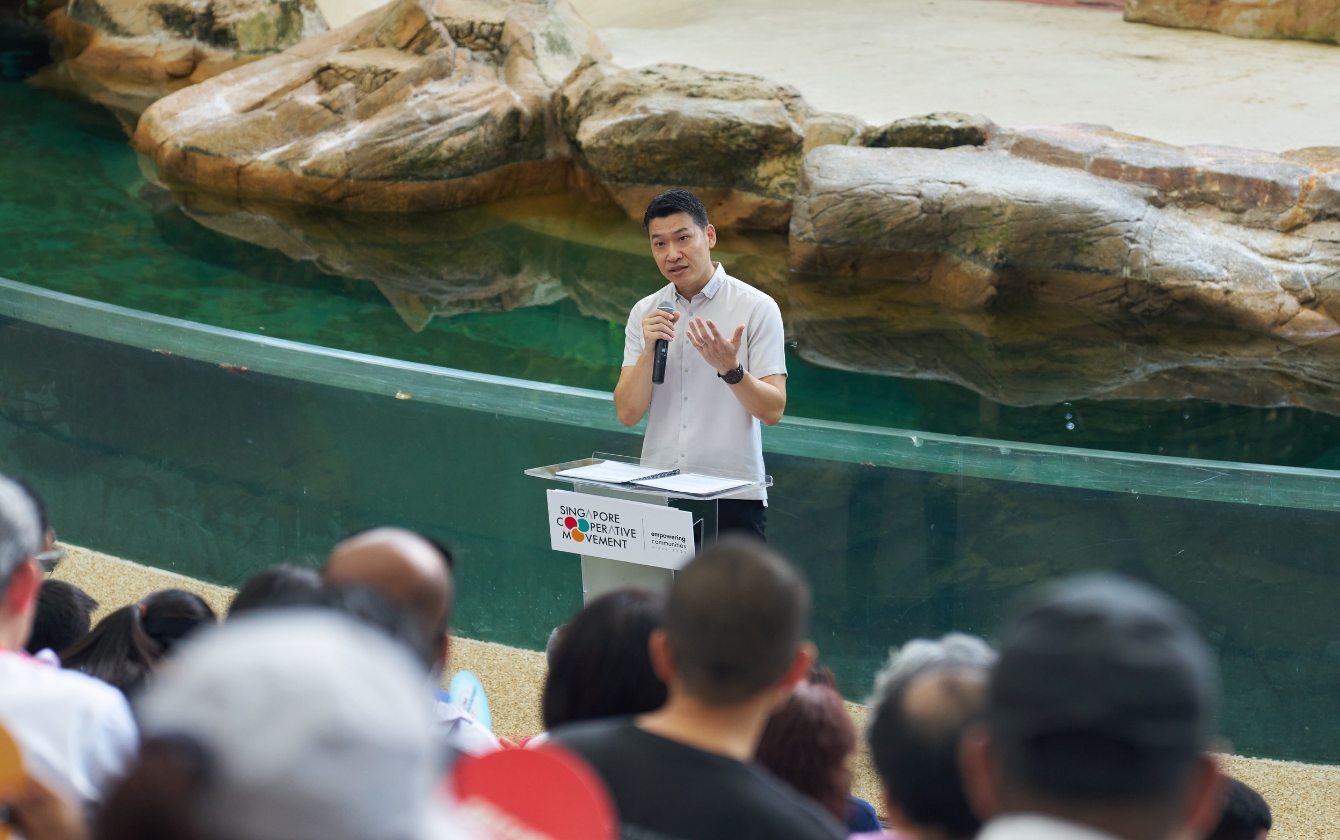
The announcement was made by Acting Minister for Culture, Community and Youth David Neo at the Singapore Co-operative Movement's (SCM) inaugural Stewardship Day at the Singapore Zoo, where over 700 co-operators, family members and partners gathered under the theme "Delivering Value through Values."
About 40% of co-operatives that currently contribute to the CCF and SLF will benefit directly, with the freed-up resources expected to go towards member welfare, community programmes and capability-building.

The change caps years of sector-level consultation. SNCF Chairperson Tng Ah Yiam said the reduction "will help co-operatives ease cost pressures and strengthen their ability to continue serving members and communities effectively."
For credit co-operatives, which have faced narrowing surpluses and lower loan disbursements in recent years, the relief is particularly welcomed. Sanjeev Tiwari, Chief Executive of AUPE Credit Co-operative and a Nominated Member of Parliament, said the savings could translate into better dividends and stronger welfare programmes for members, and potentially draw younger Singaporeans towards the co-operative model as a vehicle for social enterprise.
Shareef Bin Abdul Jaffar, Chairman of the 98-year-old TCC Credit Co-operative, said: "The reduction in the second-tier contribution provides welcome relief and gives us greater room to manoeuvre.”
Keeve Chan, Chief Executive Officer of POLWEL Co-operative, said the reduction would accelerate the organisation's ongoing investment in staff development, AI adoption and process digitalisation while expanding welfare, sports and recreational programmes for both serving and retired officers.
“As one of the fastest growing co-operatives in Singapore, this will provide a meaningful boost to our growth and ability to create even more value for our members,” he added. Police officers and Narcotics officers from the Central Narcotics Bureau are among the members behind POLWEL Co-operative.
The rate reduction sits within the broader SCM 10-year Transformation Roadmap, developed by the Singapore National Co-operative Federation (SNCF) with the Ministry of Culture, Community and Youth, which has committed up to S$30 million to the effort. The roadmap targets governance, leadership, operational scale and community outreach across the sector.
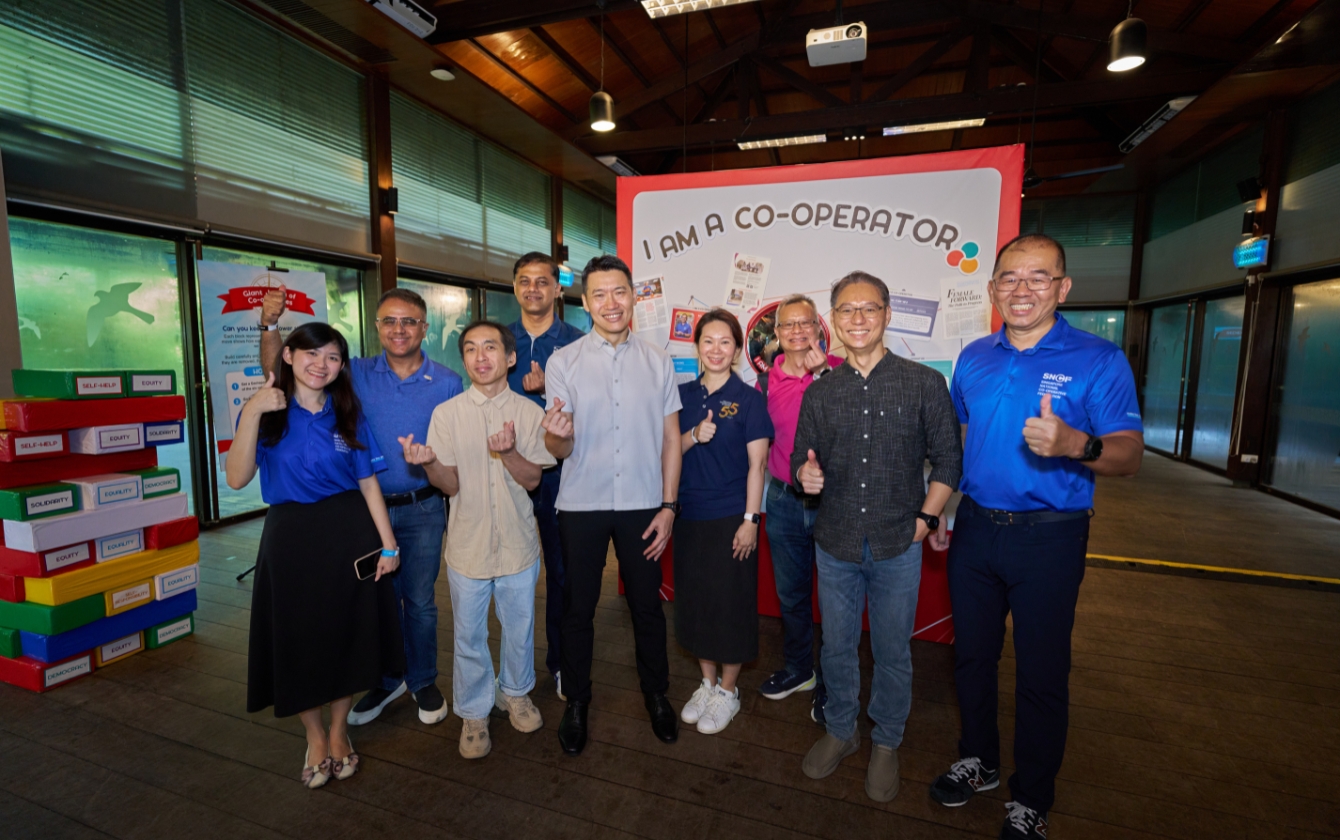
Stewardship Day itself launched a parallel agenda: a programme to develop 250 co-operative Stewards by 2035. These are individuals equipped to deepen the movement's reach and inspire new entrants. Interactive booths and a co-operative-values-themed Giant Jenga installation formed part of the day's activities, as the sector made the case that good values and sound business are not at odds.
It is a long way from where the movement began. Singapore's first co-operatives were formed in 1925, decades before independence, as a practical defence for government workers against illegal moneylenders as well as to encourage thrift amongst workers. A century later today, the movement counts 70 co-operatives and one million members across a nation of 6.11 million, still making the same argument that doing good and doing well are not mutually exclusive.
By Sng Ler Jun